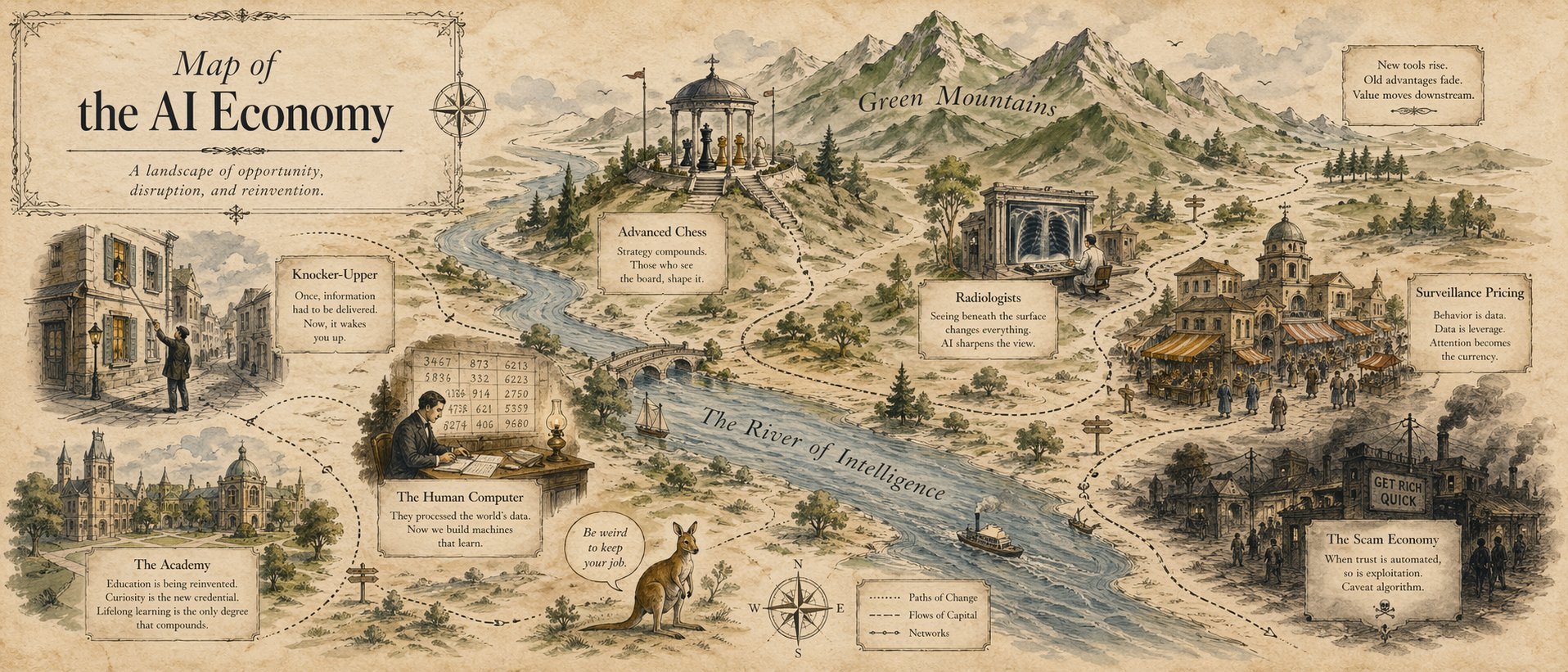
move your cursor to reveal the map beneath the hype
Economist & Author
"Concise, chatty, companionable, ever-so-savvy. There may be a more useful guide to AI out there, but why incur the opportunity cost of searching for it? Having covered AI from the jump, this is as good as it gets."Paul Solman Business & Economics Correspondent, PBS NewsHour
"This book represents the best in bringing real research to understand what is happening in our current AI-moment. Shiller has accomplished in record time an overview of many of the key issues emerging in the AI economy. An easy and informative read."Joshua Gans University of Toronto; author of Power and Prediction and Prediction Machines: The Simple Economics of Artificial Intelligence
"AI Economics brings a lively economic perspective to analyzing how AI will transform our lives. The book is informative and fun to read."Joel Waldfogel University of Minnesota, author of Scroogenomics
Click a quote, an arrow, or a dot to focus it.
Economists don't ask "can AI do this?" — they ask "which humans does AI replace, and which ones does it make richer?" Four questions, using the logic from the book.
"How weird is your job?"
"How high are the stakes when you screw up?"
"Is AI coming for the easy parts of your job, or the hard parts?"
"Would your job survive a kangaroo hopping into the room?"
(a serious question about physical chaos tolerance)

One lens to cut through all the AI hype. Before you can predict what AI will do, you need to understand who controls it—and what they want.
Read more →Your browsing history, your zip code, your timing—all of it feeds models that quietly set the price you see. Find out who wins and who loses.
Read more →Which jobs are truly safe? The answer isn't about whether AI can do them—it's about whether it's profitable to deploy AI to do them.
Read more →In an AI economy, the strangest skill is the safest one. Why unpredictability, empathy, and human weirdness may be your most valuable career assets.
Read more →AI is making fraud faster, cheaper, and more convincing. Understanding the economic incentives behind scams is your best defense.
Read more →From deepfakes to filter bubbles—what does economics predict about the future of truth? The answer is more nuanced than the headlines suggest.
Read more →